
How often a Houston chimney really needs sweeping — and what an inspection covers
Annual inspection, sweeping by usage, and the three inspection levels explained in plain language.
Two questions come up every fall: how often does a chimney need to be swept, and is an inspection the same thing as a cleaning. They are not the same thing, and mixing them up is how people end up with a flue fire in a house that was 'just serviced' last year.
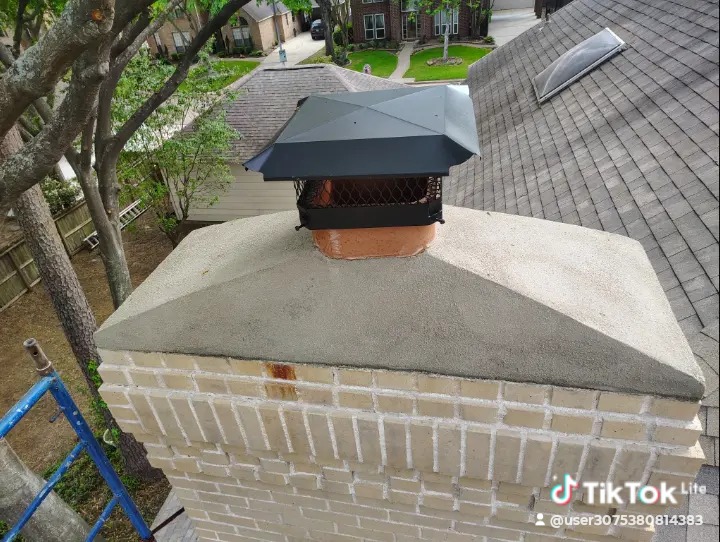
An inspection is diagnostic. A sweep is maintenance. A good contractor does the inspection first, shows you photographs, and only then tells you whether the flue needs cleaning, whether the crown is sound, and whether anything above the roofline is quietly letting water into the structure.
The industry standard is an inspection every year, regardless of how much you burn. That surprises people with gas logs, but gas appliances produce water vapor and mild acids that eat clay tile and corrode dampers, and a flue that has not been used at all is exactly where birds, squirrels and wasps set up. Sweeping frequency, by contrast, follows usage: roughly once for every cord of wood burned, or whenever creosote build-up reaches about an eighth of an inch.
Creosote is the reason any of this matters. It is condensed, unburned wood gas — tar, essentially — and it deposits on the flue wall whenever smoke cools below about 250°F on the way up. Stage one is a light, sooty dust that brushes off. Stage two is a hard, flaky, tar-like layer. Stage three is a glazed, shiny coating that has to be chemically treated or mechanically removed, and it burns at temperatures that crack clay tile and can carry fire into the framing around the chase.
Houston homeowners get complacent here because the burning season is short. The catch is that short, cool, smoldering fires — exactly the kind you light on a 55-degree December evening — deposit creosote much faster than a hot fire does. Low burn temperature, damp wood and a partially closed damper are the three fastest ways to glaze a flue.
Inspections come in three levels, and the terminology is standardized. A Level 1 inspection is the annual baseline for a chimney in continuous service with no changes: readily accessible portions of the chimney exterior and interior, the connection to the appliance, and a check for combustible deposits and obvious structural problems. That is what most homes need most years.
A Level 2 inspection adds a video scan of the flue's interior surface, plus accessible portions of the attic, crawlspace and roof. It is required when you buy or sell a house, when you change the appliance or fuel type, after a chimney fire, and after an event that could have damaged the structure — a hurricane, a lightning strike, or foundation movement. If you have never had a camera in your flue, this is the one to ask for.
A Level 3 inspection involves removing parts of the structure — a crown course, a chase cover, sometimes interior wall material — when a Level 2 has turned up something that cannot be assessed any other way. It is uncommon, and any contractor who suggests one straight away should be able to point to the exact photograph driving it.
The sweep itself is less dramatic than the name suggests. Done properly, the technician seals the firebox opening, runs a HEPA-filtered negative-air vacuum, and works the flue with rotary or manual brushes sized to the flue's actual dimensions. The soot goes into the vacuum, not into your living room. Afterwards the firebox, smoke shelf and damper get cleaned out, and the damper gets checked for full travel and seal.
What should give you pause: a quoted price with no inspection, a technician who never gets on the roof, a 'free' sweep that converts into a four-figure repair recommendation with no photographs, and anyone selling you a chemical creosote treatment as a substitute for mechanical cleaning.
On pricing signals in the Houston market, a straightforward Level 1 inspection with a standard sweep on a single accessible flue sits in the low hundreds. A Level 2 with camera scanning costs more because it takes longer and produces documentation. Repairs are quoted separately, and the common ones — a new stainless cap, a crown rebuild, flashing correction — vary enough with height, pitch and access that any number given over the phone is a guess.
The practical scheduling advice: book in late summer or early fall. Everyone in Houston calls the week of the first cold front, and by then the calendar is three weeks out. If your inspection turns up crown or flashing work, you want that done in dry weather anyway.
If you want the full scope of what we check and what we charge for, see our chimney sweep and inspection service page, and if the inspection turns up crown, mortar or flashing damage, that work is covered on our chimney repair page.
Annual chimney sweeping, creosote removal, and Level 1, 2 and 3 inspections before burning season.
See the serviceCrown rebuilds, tuckpointing, cracked mortar joints, flashing, caps, and full chimney restoration.
See the serviceThinking about a fireplace?
Custom fireplace installation, chimney repair and masonry across greater Houston — free written estimates and three decades of craftsmanship.