
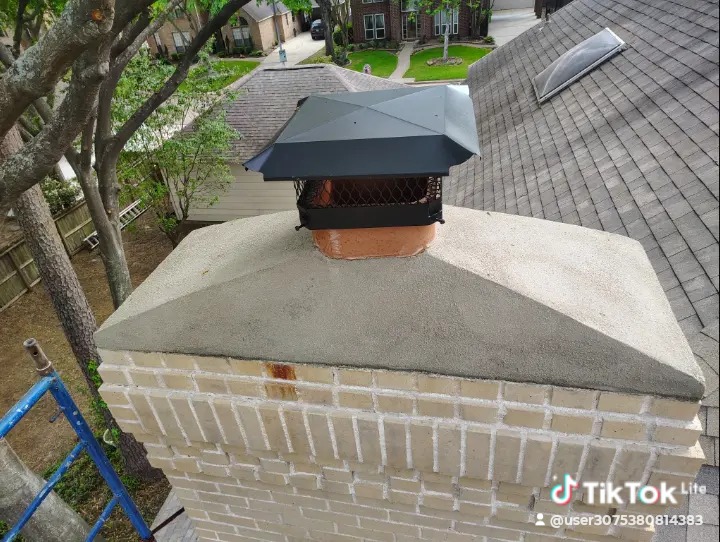
Your chimney crown is probably why your ceiling is stained
The crown is the concrete slab at the top of the chimney. When it fails, the water shows up everywhere except the crown.
Almost every chimney leak we get called to in the Houston area traces back to one component, and it is not the flashing everyone blames first. It is the crown.
Water that enters at the top of a chimney does not appear at the top of the chimney. It travels down through porous brick and the cavity behind it, and it emerges as a brown ring on a second-floor ceiling, as a musty smell near the firebox, as rust on a damper, or as efflorescence twenty feet below the actual defect. That distance between cause and symptom is why crown failure gets misdiagnosed as a roof problem so often.
A crown is supposed to be a poured, reinforced concrete slab covering the full top of the chimney, sloped to shed water, overhanging the brick with a drip edge, and isolated from the flue tile with an expansion joint. Built that way, it lasts decades.
What is actually on most chimneys in this region is a mortar wash — a thin layer of leftover mortar troweled flush from the flue tile to the outside edge of the brick. It has no reinforcement, no overhang, and no expansion joint. Mortar is not a waterproofing material and it is not dimensionally stable, so it cracks. Around here, that happens somewhere between year eight and year fifteen.
Once it cracks, three things start at once. Water enters the cavity between the flue liner and the brick and works downward. Water saturates the brick itself, and dissolved salts migrate to the surface and crystallize as the white chalky bloom called efflorescence. And water sits in the top courses, where heat cycling and salt crystallization push the outer faces off the brick — spalling.
Spalling is the point at which the repair changes category. Sound brick under a bad crown means we cut off the crown and pour a new one, and the chimney is fine. Spalled brick means the top courses have to come down and be relaid before anything can be poured on them. Extensive spalling plus a saturated cavity can mean rebuilding the stack from the roofline up.
The warning list, in the order they typically appear: hairline cracks visible in the crown from the ground; white staining on the upper brick; a rust line on the damper; a faint musty smell in the room in wet weather; flakes of brick face on the roof or in the gutters; and finally the ceiling stain that gets everyone to pick up the phone.
There is a common and expensive detour worth warning about. When the ceiling stains, the first call is usually to a roofer. The roofer sees a chimney penetration, applies roofing cement over the flashing, and the leak often pauses — because sealant temporarily interrupts one of several water paths. It comes back in a season or two, by which point the crown has had another year to work on the brick.
A proper diagnosis takes photographs from the roof, not guesses from the ground. We document the crown, the cap, the flashing detail, the top courses and the flue interior before quoting, because those five items determine whether you are buying a day of work or a rebuild.
Repair, honestly scoped: a crown rebuild with sound brick beneath is typically a one to two day job — saw-cut and remove the failed wash, install a bond break at the flue, form and pour a reinforced crown with overhang and drip edge, cure, then seal the surrounding masonry if it is porous. Add a stainless cap while the crew is up there; it is the cheapest insurance on the roof.
Preventively, the single highest-value thing a Houston homeowner can do is have the crown looked at once a year and treated with a breathable masonry water repellent — one that lets vapor out while keeping liquid water out. Film-forming sealers do the opposite and trap moisture in the brick, which is worse than doing nothing.
Crown pours, spalled brick replacement, cap and flashing correction all live on our chimney repair page, and where movement or cracking extends into the wall below the roofline, that becomes masonry repair and structural work.
Crown rebuilds, tuckpointing, cracked mortar joints, flashing, caps, and full chimney restoration.
See the serviceCracking mortar joints, structural damage, settling walls, and foundation-related masonry repair.
See the serviceThinking about a fireplace?
Custom fireplace installation, chimney repair and masonry across greater Houston — free written estimates and three decades of craftsmanship.