
A Houston homeowner's buying guide to fireplaces: budget, timeline and what drives cost
What actually moves the number on a fireplace estimate, and how to sequence the decisions in the right order.
This is the companion to the type comparison: not which fireplace, but what it costs, in what order the decisions happen, and where people waste money.
Start with the honest budget conversation. A fireplace estimate is really four separate budgets stacked together: the appliance, the venting, the utilities, and the masonry. Homeowners tend to research the first and get surprised by the other three.
The appliance is the most predictable line and often the smallest. A quality sealed direct-vent unit, an electric unit, or a listed prefab wood firebox each occupy a fairly narrow band, and the difference between a mid-range and a premium unit is usually glass, burner detail and controls rather than function.
Venting is where the number moves. A direct-vent unit on an exterior wall with a straight horizontal run through the back is the cheapest possible path. The same unit on an interior wall in a two-story house, needing a vertical run boxed through a bedroom closet and out the roof, is a materially different job with framing, drywall and roofing trades involved.
Utilities follow the same logic. If the gas meter is on the other side of the house and the run crosses a slab, you are paying for the route, the sizing, the sediment trap, the pressure test and the permit. An outlet inside the enclosure is trivial while the wall is open and expensive after the stone is set — put it in now.
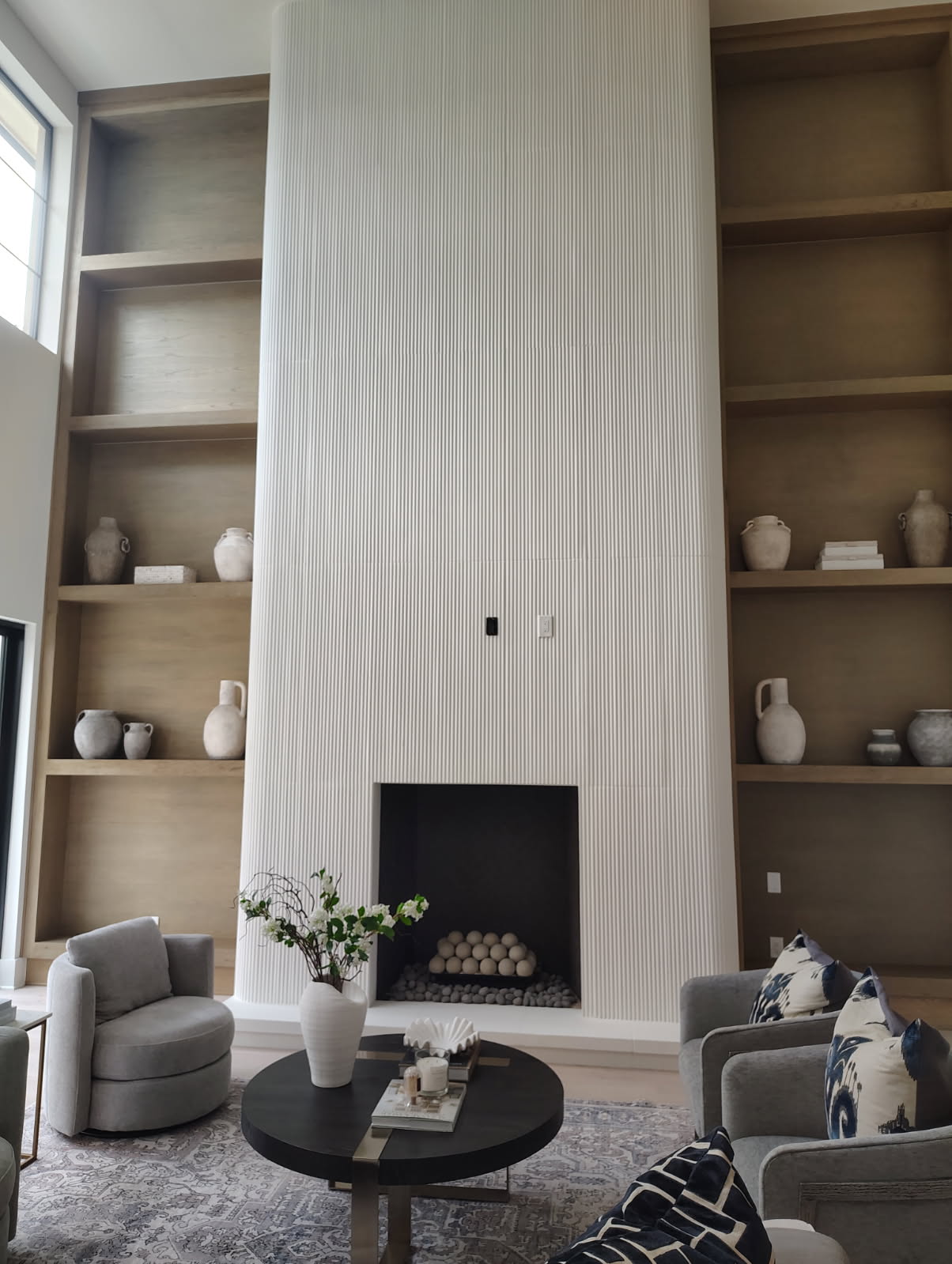
Then masonry, which is the largest variable of all and the one you control. A tile surround with a simple painted mantel is one number. A cast stone or limestone surround is another. Full-height natural stone to a twenty-foot great-room ceiling, with a stone hearth and a solid timber beam mantel, is another again. Material choice, height, and how much cutting the pattern requires are the three drivers.
Sequence the decisions in this order and you will not have to redo any of them. First: are you burning wood or not. That single answer eliminates half the options. Second: where is the fireplace going, and can it vent straight out. Third: what is the surround material and how high does it go. Fourth: the specific appliance model, which by then is a short list.
Where people waste money. Buying the appliance first, online, before anyone has looked at the wall — we regularly meet units sitting in garages that cannot be vented where the owner intended. Doing the surround in phases, so the stone from year two never quite matches year one. Choosing a dramatic full-height stone wall and then leaving a builder-standard 36-inch firebox in the middle of it, which reads as under-scaled forever. And converting a fireplace while leaving a failing crown or flashing above it, so water damages the new finish work within two seasons.
On timelines: an electric unit with a tile surround is a couple of days. A direct-vent conversion is two to four working days of site time, plus inspection scheduling. A new prefab wood fireplace with a framed chase and a stone-faced exterior is one to two weeks. A full masonry fireplace and chimney from a new footing is two to three weeks, weather dependent. Add lead time for stone selection — natural stone in particular is quarry-dependent and can add weeks.
On permits: gas work and new venting are permitted and inspected in Houston and in most surrounding municipalities. Master-planned communities in Katy, Cypress, Sugar Land, Richmond and The Woodlands frequently add HOA architectural review for anything that changes an exterior elevation, including a new chase or an outdoor chimney. Both are manageable; both add calendar days, and neither should be discovered halfway through.
What to ask any contractor for before you sign: photographs of the existing conditions, a written itemized estimate that separates appliance, venting, utilities and masonry, the permit plan in writing, the specific material and joint profile for the surround, and a clear statement of what happens if the demo uncovers rot or water damage behind the existing unit. That last clause is the one that protects both sides.
When you are ready to walk a space, our fireplace installation service covers every type discussed here, and if the project extends past the firebox into a full feature wall, hearth room or exterior elevation, that is custom masonry, brick and stone work.
Traditional masonry, direct vent, wood-burning, gas, and electric fireplaces built to fit your space.
See the serviceBrick and block work, stone veneer, columns, walls, and premier masonry for new construction.
See the serviceThinking about a fireplace?
Custom fireplace installation, chimney repair and masonry across greater Houston — free written estimates and three decades of craftsmanship.