
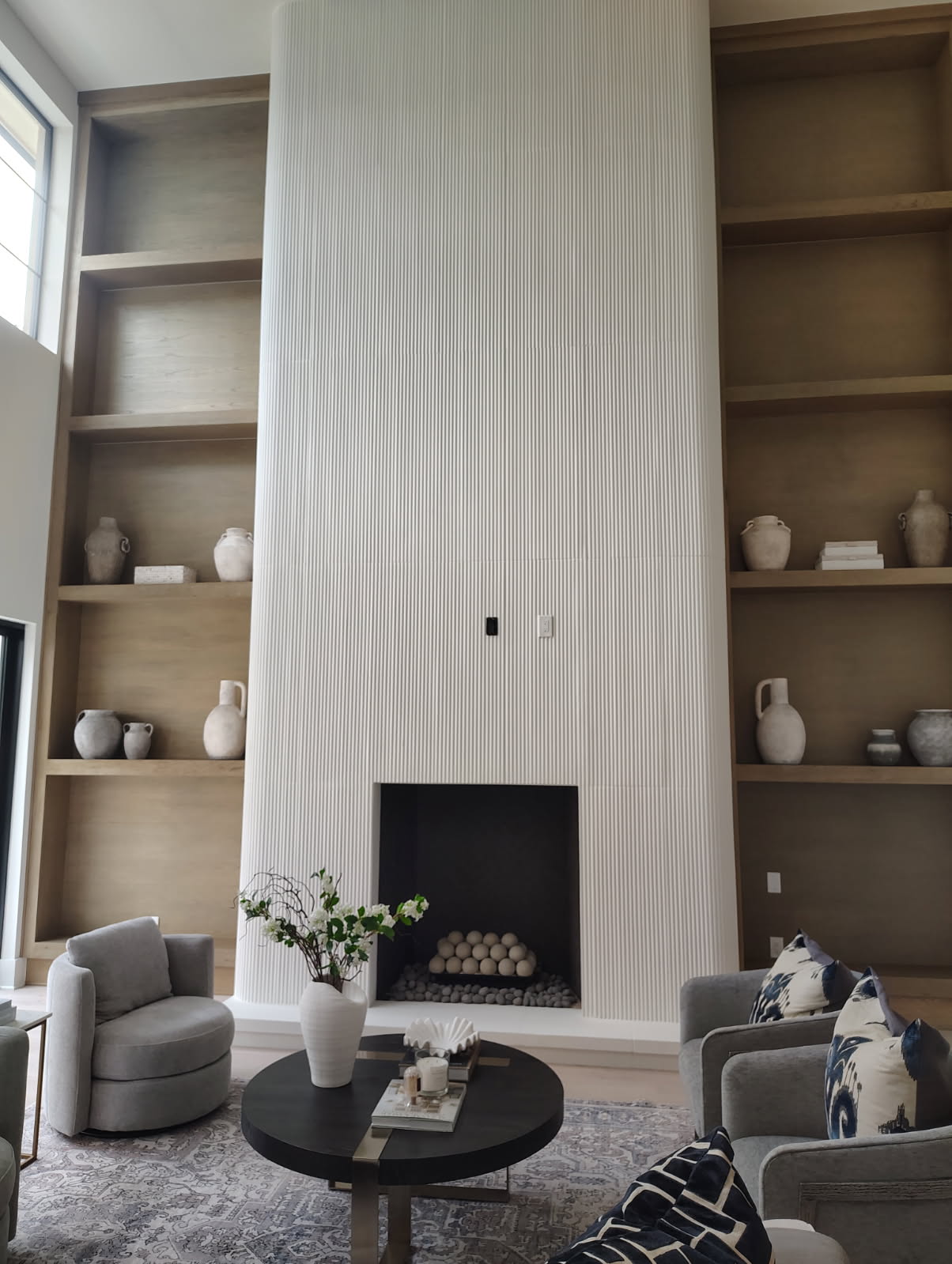
Converting an old wood firebox to sealed direct-vent gas, start to finish
The most common fireplace project we run in Houston — what's involved, what it costs you in downtime, and when to replace instead of adapt.
A very large share of Houston's housing stock has a fireplace nobody has lit this decade. Usually it is a 1970s or 1980s metal prefab firebox in a framed chase, the damper is rusted, the glass doors are smoked over, and the family long ago decided it was not worth the mess. Converting it to a sealed gas unit is the single most common project we run, and it turns dead square footage back into the focal point of the room.
The first step is not shopping for a unit. It is an honest assessment of what you already have. We look at the existing firebox for rust-through and cracked refractory panels, the chase for plumb and water damage, the flue or vent pipe for corrosion, and the framing around the opening for any evidence of past heat or water exposure.
That assessment produces one of two answers. If the existing metal firebox is structurally sound and the chase is dry and square, some units can be inserted. More often — and this is the honest answer people do not always want — the firebox is at or past its service life and gets removed entirely, along with the old vent pipe.
Sealed direct vent is what we recommend in nearly every case. The unit takes combustion air from outside through the outer wall of a coaxial pipe and exhausts through the inner one. Nothing from your house goes up the flue, which means you are no longer pulling conditioned air out of the room and up the chimney every time you light it. It also means the unit can vent horizontally through an exterior wall, so it does not depend on a tall, sound masonry flue at all.
The alternatives are worth naming. Vent-free gas units are legal in much of Texas and we do not install them in living spaces — they put combustion moisture and byproducts into the room. B-vent units are cheaper but draw room air and vent vertically, so they carry the same efficiency problem as the wood unit you are replacing. Gas logs dropped into an existing wood firebox are the cheapest path, but they require the damper to be locked partially open, which means a permanent hole in your envelope.
The gas line is the part homeowners consistently underestimate. It is not a hose. The run has to be sized to the unit's BTU demand and the distance from the meter, with a sediment trap, an accessible shutoff at the appliance, and a pressure test. Inside Houston city limits and in most of the surrounding municipalities that work is permitted and inspected, and we pull the permit rather than leaving it to the homeowner. Skipping it shows up later at resale inspection.
Electrical matters too, because modern direct-vent units want power for the blower, the electronic ignition and the remote receiver. Adding a dedicated outlet inside the firebox enclosure while the wall is open costs almost nothing; adding it afterwards means opening finished stonework.
Then the part everyone actually cares about: the surround. This is where a masonry contractor earns the job over an appliance dealer. The unit is a box; what you look at every day is the material around it, the hearth, and the mantel. We size the surround to the wall — full-height stacked stone in a two-story great room, a cleaner cast-stone or limestone frame in a formal room, tile with a heavy timber mantel in a bungalow. Hearth extension depth is dictated by the unit's listing, and mantel clearance above the opening is a code item, not a taste item.
Timeline on a typical conversion: demo and removal in a day, gas and vent rough-in plus inspection in a day or two depending on the inspector's schedule, unit set and framing on the same visit, then two to four days of masonry and finish work depending on material. Most jobs run two to four working days of on-site time spread across a week or so.
Costs scale with three things and not much else: whether the gas has to be run a long way, whether the venting can go straight out the back or has to be re-routed, and what the surround is made of. The unit itself is rarely the largest line on the estimate.
One last thing worth saying plainly: if your plan is to keep burning wood, do not convert. A properly rebuilt firebox and a relined flue give you real fire and real radiant heat, and we do that work too. Conversion is for the household that wants heat and ambience on a switch, in January, without hauling wood.
Read the full scope on our fireplace installation page, and if the assessment turns up crown, flashing or flue damage on the existing chase, that falls under chimney repair.
Traditional masonry, direct vent, wood-burning, gas, and electric fireplaces built to fit your space.
See the serviceCrown rebuilds, tuckpointing, cracked mortar joints, flashing, caps, and full chimney restoration.
See the serviceThinking about a fireplace?
Custom fireplace installation, chimney repair and masonry across greater Houston — free written estimates and three decades of craftsmanship.