
Gas, wood or masonry: comparing fireplace types for a Houston home
Venting, gas availability, structural load and how often you'll actually light it decide this, not taste.
Every fireplace conversation starts the same way: what kind should we get. The honest answer depends far less on taste than on your walls, your venting, your gas service and how many nights a year you will genuinely light the thing.
Here is the comparison the way we lay it out on a site visit.
A full masonry fireplace is the real article: a firebrick firebox, a properly proportioned throat and smoke chamber, a flue built into a masonry stack, and radiant heat that keeps warming the room long after the fire has gone down. It is also the heaviest and most expensive option by a wide margin, and it needs a footing engineered to carry it. In existing construction that usually means a new footing poured outside the building line. In new construction, decided early, it is straightforward. Expect two to three weeks of build time.
A prefab wood-burning firebox gives you real fire at a fraction of the cost. It is a listed metal unit in a framed chase with a Class A metal chimney, and once the chase is faced in brick or stone it reads as masonry from the street. You get flame and some radiant heat, but not the thermal mass of true masonry. Service life is typically 20 to 30 years, which is why so much of Houston's 1980s stock is due for replacement now.
Sealed direct-vent gas is the practical choice for most Houston retrofits and most new builds here. Combustion is sealed behind glass, air comes in and exhaust goes out through a single coaxial pipe, and it can vent horizontally through an exterior wall with no chimney at all. It lights from a switch or a phone, produces usable heat, and it is the only type in this list that people in this climate actually operate casually on a mild evening.
Gas logs in an existing wood firebox are the budget path. They are visually convincing and cheap to install, but the damper must be locked partially open for safety, so you have a permanent opening in your building envelope and the efficiency is negative — you lose more conditioned air than you gain heat.
Electric installs anywhere there is an outlet and costs the least of anything here. There is no venting, no gas, no combustion and effectively no meaningful heat. In a bedroom, an apartment-scale space, or a wall where venting is genuinely impossible, it does the visual job honestly. Do not buy it expecting warmth.
Now the Houston-specific filter. We are in a climate with maybe 15 to 30 fireplace-worthy evenings a year. That single fact pushes most households toward direct-vent gas, because a wood fire requires planning — wood, kindling, ash removal, damper management, an hour of commitment — and a gas unit requires none of it. Households that burn wood anyway are usually on wooded lots in Spring, Klein, Tomball or the older Woodlands villages, where there is a genuine culture of it and the fireplace is a real winter feature.
The second filter is structure. If you want a full masonry fireplace in an existing slab-on-grade house, budget for the footing before you fall in love with the stone. If your house is two-story with the fireplace on an interior wall, direct venting gets complicated fast and a vertical run may be the only option.
The third filter is what happens at resale. In this market, a clean, functional, well-detailed fireplace reads as an asset and a dated one reads as a project. A neglected wood unit with smoked glass doors and a rusted damper actively costs you at inspection. That is often the deciding argument for conversion.
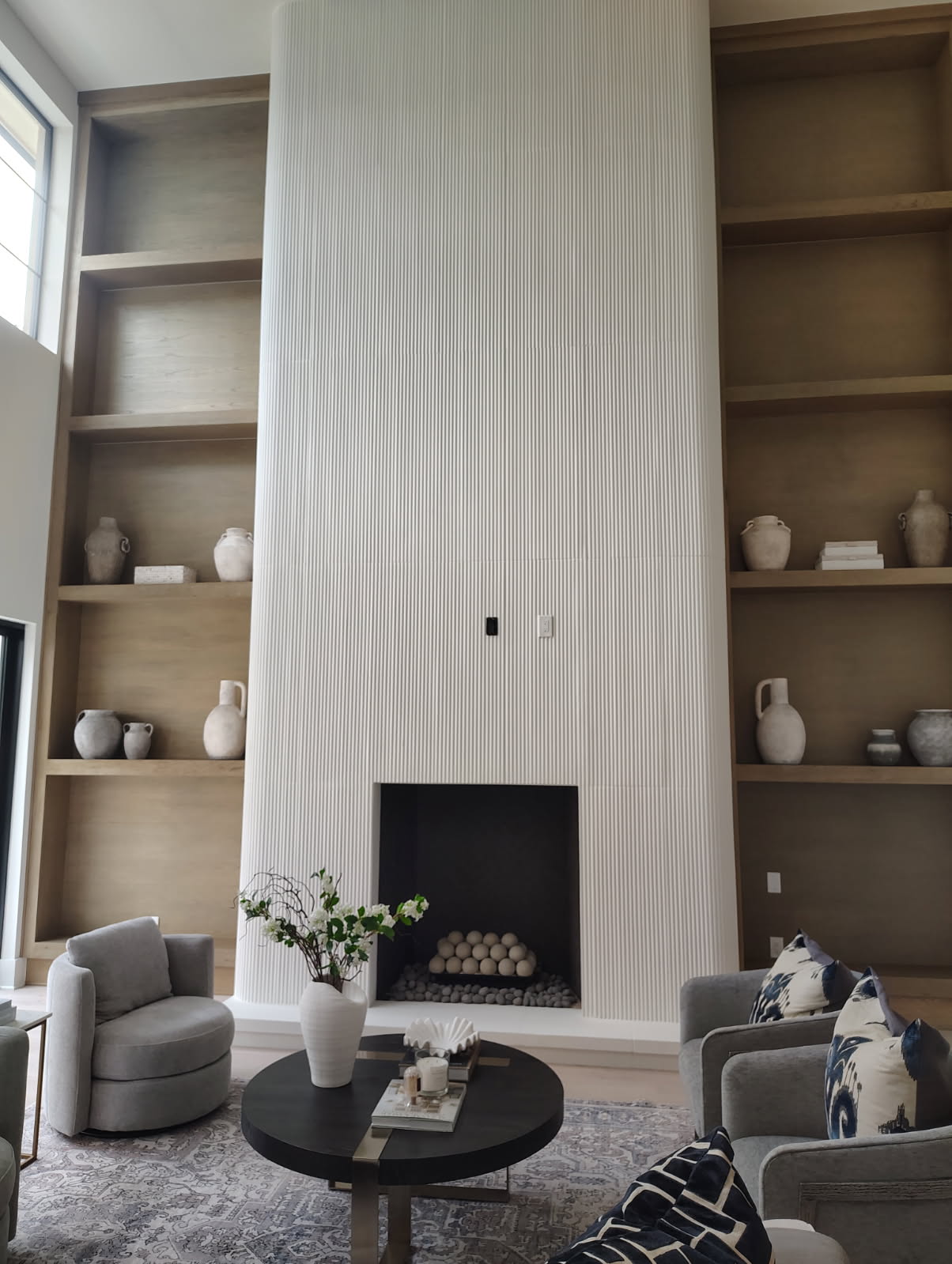
Finally, and we say this on every visit: the unit is not the design. The surround is. Brick, natural stone, cast stone, limestone, tile, plaster — that is what your eye lands on a hundred times a day, and it is where the proportion, the joint lines and the mantel scale either look intentional or look bought. Two identical direct-vent inserts, one framed in drywall and one in full-height stone, are not the same room.
If you are weighing options for an indoor build, our fireplace installation page walks through each type and what we install. If the fireplace is destined for a covered patio instead, the considerations change — chimney height above the roof structure, wind exposure, materials that survive weather — and that is covered under outdoor kitchens and outdoor living.
Traditional masonry, direct vent, wood-burning, gas, and electric fireplaces built to fit your space.
See the serviceOutdoor fireplaces, brick pizza ovens, built-in kitchens, and patio living spaces designed for Texas evenings.
See the serviceThinking about a fireplace?
Custom fireplace installation, chimney repair and masonry across greater Houston — free written estimates and three decades of craftsmanship.