
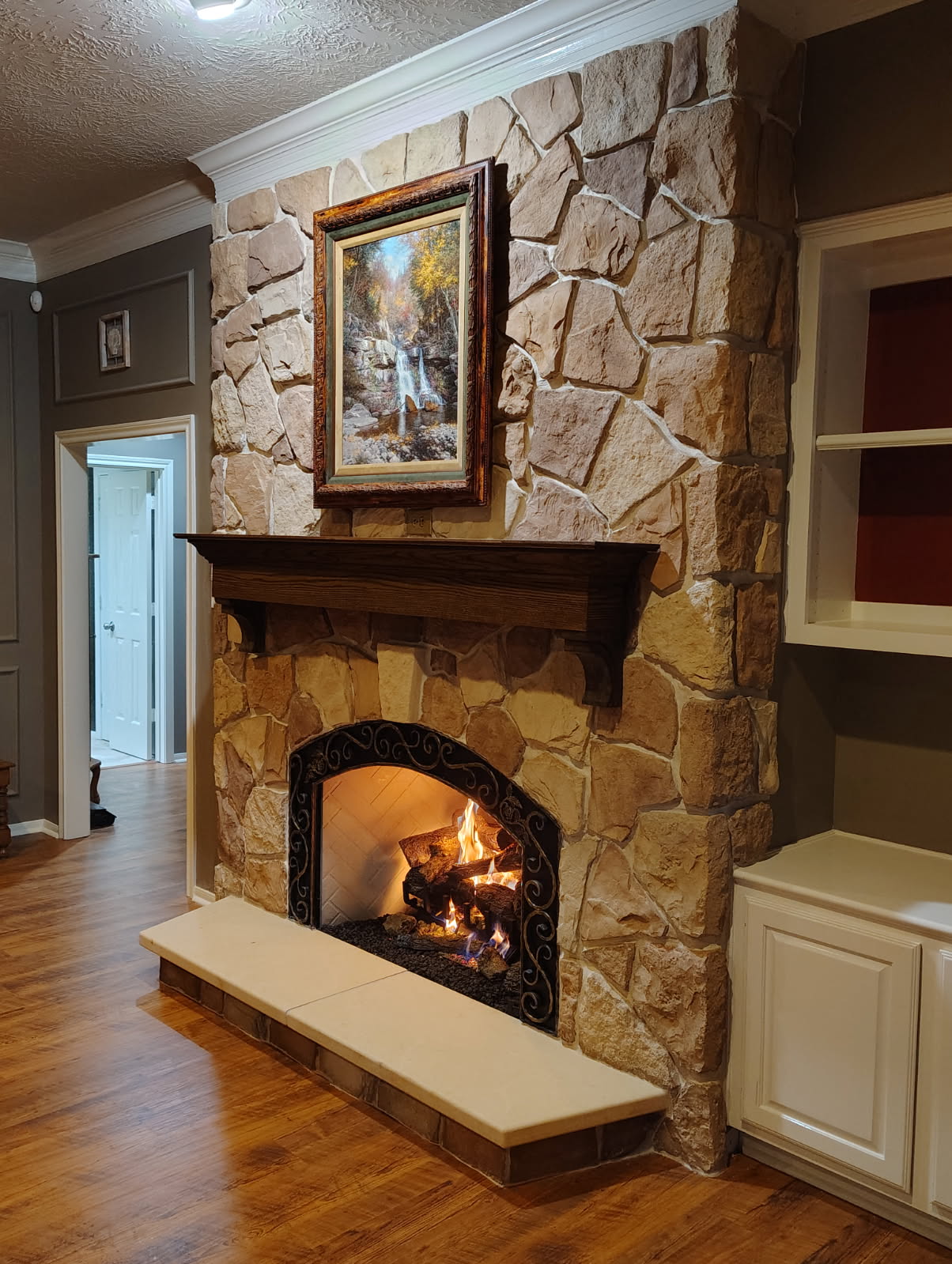
Fireplace Installers in Houston: 7 Questions to Ask Before You Hire
Most of the money in a fireplace job is spent behind the wall, where you cannot see it. These questions get it out in the open before you sign.
Choosing a fireplace installer in Houston is harder than it should be, because almost everything that determines whether the job goes well happens behind the wall. The veneer you can judge by looking at it. The firebox, the venting run, the gas line and the permit you cannot, and those are where the money and the risk actually sit.
We have been building fireplaces in this market since 1992. Below are the seven questions we would want a homeowner to ask us and ask everyone else quoting the same job. Good answers come easily to a real installer. Vague answers tell you what you need to know.
1. Who actually lays the firebox, your crew or a subcontractor?
There is a real difference between a company that sells and installs appliances and a masonry company that builds. A sealed gas insert can be set by a competent installer in a day. A hand-laid refractory firebox with a properly shaped throat and smoke chamber is masonry work, and the person doing it either does it every week or does not.
Ask who will be standing in your living room. Ask whether the same crew handles demolition, framing, firebox, veneer and mantel, or whether four different companies pass the job along. Every handoff is a place for a detail to get dropped, and it is also the reason nobody wants to own the problem later.
2. Show me the venting plan before you give me a number.
Venting is the single biggest swing in cost and difficulty on a gas installation, and it is the thing most likely to be glossed over on a first visit.
A short horizontal direct vent straight out through an exterior wall is a quick, clean job. A vertical run that goes up through a second floor, through the attic and out the roof means framing a chase, firestops, a roof penetration, flashing and a cap, several times the work and material. Appliances also cap the total run length and the number of elbows, so a long or awkward route can force a different unit than the one you were shown in the showroom.
If an installer quotes before deciding where the vent goes, they are guessing, and you will find out which way they guessed once the wall is open.
3. Is this permitted work, and who is pulling the permit?
Gas, venting and structural work is permitted in Houston and in the surrounding jurisdictions. It takes scheduling time and it belongs on the estimate as its own line.
The answer you want is a plain yes, with the installer pulling it. The answer that should stop the conversation is any version of we do not usually bother or it is easier if you pull it as the homeowner. Unpermitted gas work is a problem at resale, a problem for your insurer if there is ever a claim, and a signal about how the rest of the job will be run.
4. What happens to the gas line?
Three things decide this: how far the meter is from the fireplace, what has to be opened up to route the pipe, and whether the existing line still has capacity once the furnace, range and water heater have taken their share.
Sometimes the answer is a short tee off a nearby branch. Sometimes it is a new line run the length of the house. Those are very different jobs, and an installer who has looked at your meter and your appliances can tell you which one you have. One who has not will find out later, on your dime.
5. Is the estimate written, and is it itemized?
A verbal number is not a quote. A written, itemized estimate lets you see what you are buying and compare two companies on equal terms rather than on a single figure.
A complete fireplace installation estimate should break out floor protection and demolition, framing and structural work, venting components and termination, the gas line and pressure test or the electrical circuit, the appliance or hand-laid firebox, veneer material and labor, mantel and hearth, permits and inspection, and the final clean and test fire.
The rule worth holding anyone to: if it is not on the estimate, it is not in the job. And if something turns up behind a wall that nobody could have seen, you should get a photograph and a written change order before the crew carries on.
6. Are you licensed and insured, and can I see the certificate?
Ask for general liability and workers compensation, and ask to see the certificate rather than taking the answer on trust. Workers comp is the one homeowners forget. If an uninsured crew member is hurt on a build inside your house, that exposure has to land somewhere, and you do not want it to be your homeowner policy.
Artex carries both, and we will send the certificate before the crew shows up.
7. Can I see a build you finished near me?
Houston is not one market. A build in a Bridgeland or Cypress master-planned community brings ARC review, questions about chimney height, chase materials and street-facing elevations. A 1960s ranch inside the Loop brings a different set of problems, expansive clay soil, an existing chimney of unknown condition, and a firebox that may have been patched three times already.
An installer who works your side of town regularly can tell you which of those you are dealing with before they quote. We build most often in Houston, Cypress, Katy, Bridgeland, Spring, The Woodlands, Tomball, Sugar Land, Richmond and Conroe, and the ARC habits in each of those communities are easier to answer before a submission than after a rejection.
The answers that should end the conversation
A firm price over the phone, before anyone has seen the wall, the venting route or the gas meter. No permit, or a suggestion that you pull it yourself. A refusal to put the estimate in writing, or a single lump-sum number with no lines. No photographs of anything found behind a wall, just a verbal we had to do extra work. A quote that assumes your existing chimney is sound without a camera ever going up the flue.
What to do with the answers
Ask all seven of the same two or three companies and the differences show up fast. One will have looked at your meter. One will have walked the vent route. One will hand you a document instead of a number.
That is the whole test, and it costs you nothing but an hour.
FAQ
How long does a fireplace installation take in Houston? It depends almost entirely on scope. A sealed direct-vent unit into an existing, sound opening is a short job. A hand-laid masonry firebox with a new chimney, a chase and stone veneer runs for weeks, and permit inspection scheduling sits inside that window. Any installer who has seen your room should be able to give you a working schedule with the estimate.
Do I need a permit to install a fireplace? For gas, venting or structural work, yes, in Houston and in the surrounding jurisdictions. Your installer should pull it and show it on the estimate as its own line item. Electric units with no gas and no venting are the usual exception, though the circuit still has to be done correctly.
Can you install a fireplace in a house that never had one? Yes. That is a framing, venting and gas-routing question rather than a fireplace question, which is why the walkthrough matters so much. Where the unit can go is decided by the vent route and the gas line, not by where the furniture currently sits.
Why will nobody give me a price over the phone? Because the variables that decide the number, opening size and location, venting run and type, gas line distance and capacity, veneer material, mantel and hearth work, and the condition of any existing chimney, are physical things inside your house and invisible from a web form. Read more about what actually affects fireplace installation cost.
What if my existing chimney turns out to be in bad shape? Then it gets corrected before a new appliance goes in. A cracked liner, a spalling firebox, a failed crown or a rusted chase cover all have to be dealt with first. You should see photographs of the finding and a written change order before that work starts, not a verbal explanation afterwards.
Traditional masonry, direct vent, wood-burning, gas, and electric fireplaces built to fit your space.
See the serviceGas and wood-burning fireplace repair — pilot lights, valves, thermocouples, gas logs, cracked fireboxes, dampers, and smoke problems.
See the serviceHiring someone this fall?
Ask us all seven. We build fireplaces across Houston, Cypress, Katy, Bridgeland, Spring, The Woodlands, Tomball, Sugar Land, Richmond and Conroe, licensed, insured, and building since 1992. Free written, itemized estimate.