Outdoor Fireplaces and Venting: The Part Contractors Get Wrong
An outdoor fireplace that smokes into the seating area was not bad luck. It was a design decision, usually made by someone who does not build fireplaces.
The part of an outdoor fireplace that contractors get wrong is the part you cannot see: the relationship between the firebox, the throat, the smoke chamber and the chimney that decides whether smoke goes up the flue or out into your seating area. An outdoor fireplace that smokes is not unlucky. It was built wrong, and it was almost always built wrong by someone who builds patios, not fireplaces.
This is the single most common problem we are called to diagnose on outdoor builds around Houston, Katy and Conroe, and it is worth understanding before you hire anyone, because the fix after construction is far more involved than getting it right the first time.
Why outdoor fireplaces are harder to get right
An indoor fireplace works in a controlled environment: the house shelters the flue, the air is still and the temperatures are moderate. An outdoor fireplace works in wind, in swirling air off the house and the fence, in Houston's shifting Gulf breeze. The draft has to be strong enough to win against all of that, every time, from the first match.
That means the margins that are acceptable indoors are not acceptable outside. The chimney has to be tall enough to clear the turbulence zones created by the house, the patio cover and nearby trees. The firebox has to be proportioned to the flue so the draft has authority over the whole opening. And the throat and smoke chamber, the transition between the firebox and the flue, have to be shaped to gather the smoke instead of spilling it.
The proportions that decide everything
Fireplace draft is geometry. The opening of the firebox, the area of the flue and the height of the chimney exist in a relationship that masons have worked out over a very long time, and when that relationship is respected the fireplace draws cleanly and when it is ignored the fireplace smokes. The failure pattern is almost always the same: a big, dramatic, wide-open firebox, because it looks impressive, paired with a flue and chimney sized by guesswork. The firebox swallows the draft and the smoke rolls out the front, onto the seating, every single time.
We deliberately do not publish the dimensional rules here, not because they are secret but because they interact: the right flue size depends on the opening, the height, the fuel and the site conditions, and a number lifted from an article and applied to your patio is how smoking fireplaces get built. This is what the design visit is for.
The throat and smoke chamber nobody photographs
Between the firebox and the flue is the part of the fireplace that never appears in the inspiration photos: the throat, the damper if there is one, and the smoke chamber that funnels everything into the flue. In a hand-laid masonry fireplace this transition is shaped and parged smooth so the smoke accelerates cleanly into the flue. In a badly built one it is a rough, abrupt step that creates turbulence exactly where the draft can least afford it. You cannot see it when the fireplace is finished. You can absolutely smell the difference when it is lit.
Wind, site and the things outside the fireplace
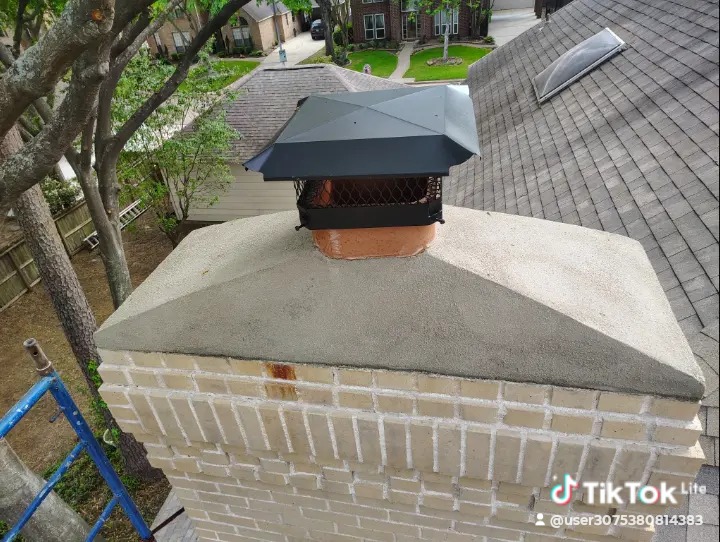
Even a perfectly proportioned fireplace can be defeated by its site. A chimney that terminates below the roofline of the house next to it lives in that roof's turbulence. A patio cover too close to the chimney cap traps smoke and stains the cover. Prevailing wind that hits the opening head-on pushes smoke out the front no matter how good the draft is. These are siting problems, and they are solved at design, with chimney height, placement and sometimes a properly designed cap, not after the stone is laid.
Gas outdoors changes the rules, not the need for design
A gas outdoor fireplace has no smoke to manage, but it has combustion air, venting and clearances of its own, set by the manufacturer, and the enclosure has to be built to them. The outdoor version of getting this wrong is a unit that burns poorly, soots its own surround or shuts itself down. Different failure, same cause: the enclosure was built without the unit's requirements in hand.
What to ask before you hire
Ask whoever is quoting your outdoor fireplace one question: how do you size the flue and chimney for the firebox you are proposing? A fireplace mason answers that question immediately and specifically. A patio contractor who also does fireplaces usually answers it with a compliment about your yard. That answer, more than any photo portfolio, tells you whether your fireplace will draw or smoke. Our outdoor living work starts with exactly that math, because a fireplace you cannot sit in front of is a very expensive garden ornament.
What a proper build looks like from the ground up
A correctly built outdoor masonry fireplace starts with its own footing, sized for the load, because a masonry fireplace is far too heavy to sit on a patio slab. The firebox is laid in firebrick with refractory mortar, the throat and smoke chamber are shaped and parged smooth, and the chimney rises to a height chosen for the site, not for the budget. The veneer, the hearth and the cap are the visible finish on top of that structure. When you interview builders, ask to see one of their fireplaces lit, not just photographed. A fireplace that draws on a breezy Houston evening is the only portfolio piece that matters.
Frequently asked questions
Can a smoking outdoor fireplace be fixed? Usually, yes, but the fix depends on the cause: sometimes it is chimney height or a cap, sometimes the throat, and sometimes the proportions themselves, which is the involved one. A diagnosis visit comes first.
Is a taller chimney always better? Taller helps draft, but it is not a substitute for correct proportions, and it has to be designed to look right on the structure. Height is part of the design, not a patch.
Outdoor fireplaces, brick pizza ovens, built-in kitchens, and patio living spaces designed for Texas evenings.
See the serviceBrick and block work, stone veneer, columns, walls, and premier masonry for new construction.
See the servicePlanning an outdoor fireplace?
Call Artex at (281) 570-9408. We design and build outdoor fireplaces across the Houston area that draw properly from the first fire. Building in Houston since 1992.