
Outdoor Fireplace vs. Fire Pit: Which One Fits Your Houston Yard
Both look good in a photo. Only one usually works in the yard you actually have.
Almost everyone starts this conversation with a photo, a stone fireplace against a covered patio, or a low round pit with chairs pulled up to it. Both look good in a picture. Only one usually works in the yard you actually have.
We have been building masonry in this market since 1992, and the decision almost never comes down to taste. It comes down to four things: room between the structure and the property line, what the soil is going to do, where the smoke goes, and what the architectural committee will approve. Get those right and either one is a good build. Get them wrong and you have a permanent, heavy mistake in the middle of the yard.
The short version
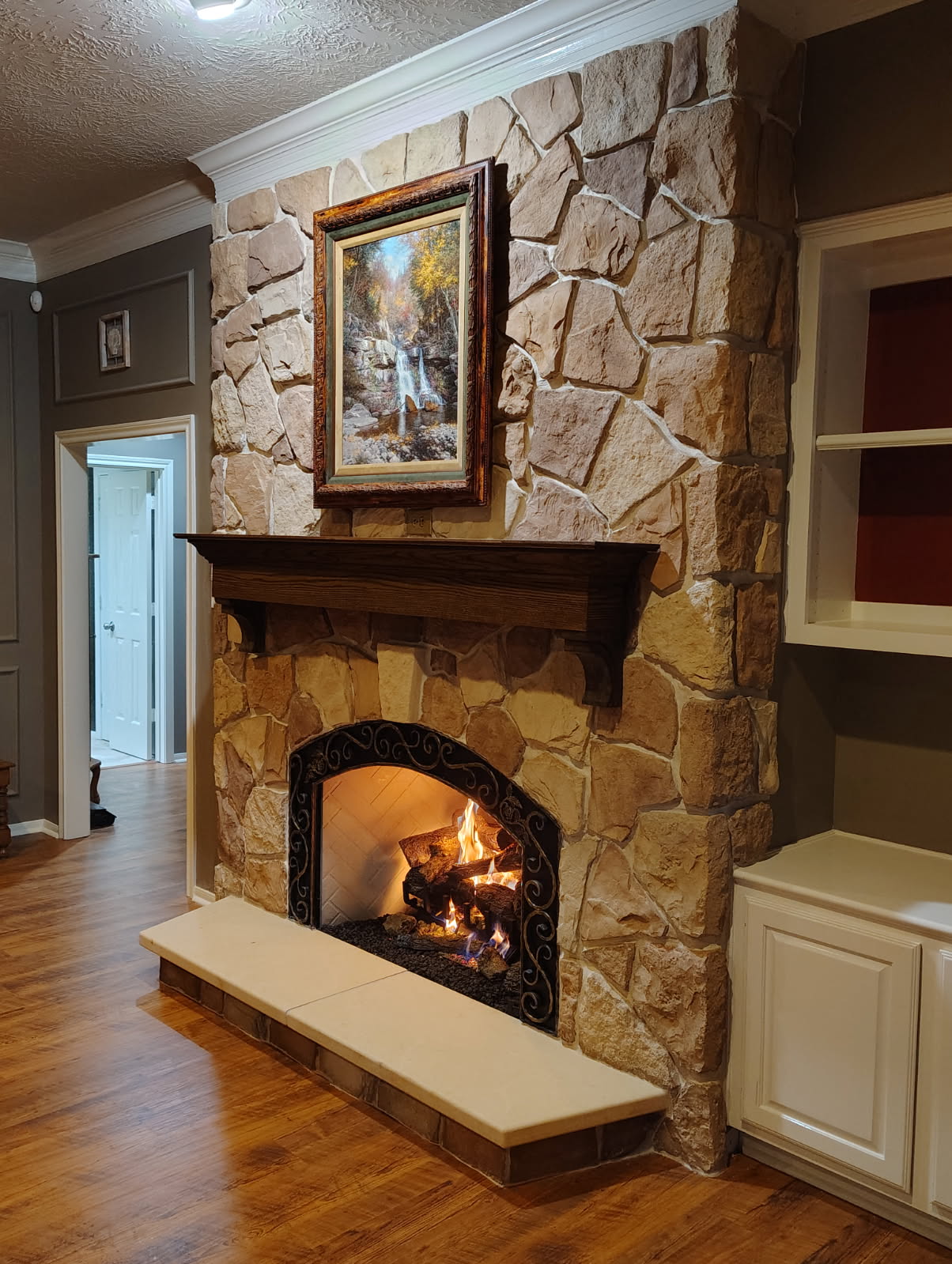
A built-in outdoor fireplace is a vertical structure, footing, firebox, smoke chamber, flue and chase, terminating high enough to draw properly. It anchors one edge of a patio, blocks wind and gives the space a wall. It needs real square footage and clearance, and it is the more involved build.
A built fire pit is horizontal. Open on all sides, seating all the way around, no flue. It takes far less room and does not block a view, the right answer for a smaller yard, a yard where the view matters, or a household that wants people facing each other rather than a wall.
Want a focal point and a windbreak? The fireplace. Want people around a circle? The pit. Everything after this is whether your yard will let you.
What a masonry outdoor fireplace actually involves
The part you see is the veneer. The part that decides whether you still like it in ten years is behind it. It starts with a footing sized for the mass above it, poured below grade so the structure moves as one piece. Then a firebox, hand-laid refractory or a modular masonry system, with the throat and smoke chamber shaped so the fire pulls instead of rolling smoke back onto the patio. Then the flue stacked plumb, the chase around it, and the veneer up the elevation.
What surprises people is height. Built close to the house, an outdoor fireplace has to terminate above the nearby roofline to draw properly, usually taller than the rendering suggested. This is a structural build, not a decorative one, and it wants a footing and a drainage plan before it wants a stone selection.
What a built fire pit actually involves
A masonry fire pit is a shallower build but still a build. An excavated and compacted base, a drainage layer, a structural ring, a firebrick or steel liner on the inside face where the heat lives, and a cap wide enough to sit on.
Drainage matters as much as anything: an open pit here fills with rain, and standing water in masonry that later gets hot is how caps crack. The bigger fork is fuel. Wood means real flame and no gas work, but also ash, wind-driven smoke, and a hard rule about overhead clearance. Gas means a run from the meter, a burner and a shutoff, and no ash, and it means the pit is on all evening rather than only when someone feels like building a fire. The one that turns on is the one that gets used.
The four things that decide it in a Houston yard
1. The soil. Much of this region sits on expansive clay that swells when wet and shrinks when dry, and in a Houston summer it does both in the same month. That movement cracks patios, and it cracks a fire feature set on a thin slab or on grade. A properly sized footing and a base that drains are not upsells here, they are why it stays square.
2. The architectural committee. In a master-planned community, Bridgeland in Cypress, the Cross Creek and Aliana side of Richmond, the Cinco Ranch and Katy corridor, most newer Tomball and Spring developments, a permanent masonry structure in the back yard is an ARC submission. They will want elevations, materials, height and placement relative to the fence line. Normal and approvable, and far faster submitted before the footing is poured.
3. Setbacks and clearances. Distance to the property line, distance to the structure and overhead clearance are set by the jurisdiction and the community, and they are not the same in every one of these towns. Get the numbers for your address before the design is locked. A fire pit that has to move four feet is a redesign of the whole patio.
4. Whether it is going under a cover. This is the one that catches people. An open fire pit under a covered patio has nowhere to send smoke and puts heat straight into the structure. Under a cover you want a fireplace with a proper flue, or a gas feature rated for it.
How this usually lands, by area
Richmond and the Fulshear side. Newer construction, generous lots, active architectural committees. Both builds work here, and this is where we see the most interest in a fire pit as the center of a larger outdoor room.
Katy and Cinco Ranch. Tighter side yards on many of these plans, and covered patios are common, which pushes the answer toward a fireplace with a real flue, built into the end of the cover.
Cypress and Bridgeland. Master-planned, so plan on the ARC submission. Bridgeland lots back onto green space and water, and when a yard has a view worth keeping, a low fire pit is almost always the better call. A fireplace puts a wall in front of the thing you paid for.
Spring, Tomball and The Woodlands. Mature trees are the constraint here, and overhead clearance drives the decision more than square footage. A fireplace needs a clean vertical path; a pit under a canopy needs a hard look at what is above it.
How we build it
One crew, footing to the last struck joint. We walk the yard, confirm the setbacks and community requirements for your address, and lay out the footprint on the ground so you can stand in it before anything is poured.
Artex has been building masonry and fireplaces in the Houston area since 1992. Licensed and insured, general liability and workers compensation, certificate sent before the crew shows up.
Frequently asked questions
Can I put a fire pit under my covered patio? Usually not, and it is the most common redesign we run into. An open pit under a cover has no path for smoke and puts heat into the structure. Under a cover you want a fireplace with a flue that terminates above the roof, or a gas unit rated for it.
Do I need a permit? It depends on the jurisdiction, on whether gas is involved, and on the community. Gas work is the usual trigger. We confirm what your address requires as part of the estimate, and a permit belongs on that estimate as its own line, not as a surprise.
Gas or wood outdoors? Wood gives you real flame and no gas line. Gas gives you a feature that turns on, which means it gets used on a Tuesday. In a small yard, gas also removes the smoke problem entirely. We build both and will tell you straight which suits your yard.
Will Houston clay soil crack it? It will if the base is wrong. Expansive clay moves with moisture, and a fire feature set on grade or on a thin slab moves with it. A footing sized for the load with a base that drains keeps it square, the most important part of the build, and the one you will never see.
Get a real number for your yard
The only way to know which one fits is for someone to stand in the yard, the cover, the fence line, the trees, the slope, and tell you. We do that for free and put it in writing.
Outdoor fireplaces, brick pizza ovens, built-in kitchens, and patio living spaces designed for Texas evenings.
See the serviceBrick and block work, stone veneer, columns, walls, and premier masonry for new construction.
See the serviceOutdoor fireplace or fire pit?
Call Artex at (281) 570-9408 for a free written, itemized estimate on an outdoor fireplace or fire pit. Building in Houston since 1992, serving Houston, Cypress, Katy, Bridgeland, Richmond, Spring, The Woodlands, Tomball, Sugar Land and Conroe.